



Download Brochure
Request A Quote
Other Products
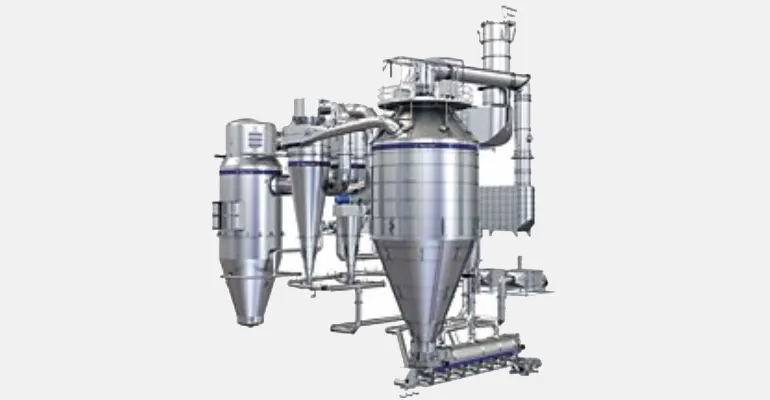
Spray Dryer
The working principle of a spray dryer is a continuous, single-step process that converts a liquid
feed (solution, suspension, or emulsion) into a dry powder by rapidly evaporating the solvent,
typically water, using a hot gas. The first critical stage is atomization, where the liquid feed is
transformed into a fine mist of droplets. This is achieved using specialized devices like rotary
atomizers (spinning disks) or pressure/two-fluid nozzles. The goal of atomization is to maximize the
surface area-to-volume ratio of the material. By dispersing the liquid into tiny droplets, the surface
area for heat and mass transfer is exponentially increased, which is the key to achieving
instantaneous drying.
Following atomization, the fine droplets are immediately introduced into the drying chamber where
they contact a high-volume stream of hot drying gas, most commonly air. The gas, heated to a high
inlet temperature, rapidly transfers heat to the massive surface area of the droplets. This heat causes
the solvent to evaporate almost instantly. Due to the rapid flash-evaporation, the droplet temperature
remains low (near the wet-bulb temperature), which protects heat-sensitive materials like
pharmaceuticals, enzymes, and food products from thermal degradation, despite the high
temperature of the inlet air.
As the moisture rapidly leaves the droplets, the solid content within each one precipitates and forms
a dry, solid particle. This entire moisture evaporation and particle formation process occurs in a
matter of a few seconds, preventing the partially dried material from adhering to the chamber walls.
The flow pattern of the hot gas—either co-current (moving in the same direction as the spray) or
counter-current (opposite direction)—is carefully chosen to optimize heat transfer and final product
properties such as particle size, density, and morphology. A co-current flow is often preferred for
heat-sensitive materials as the wettest product contacts the hottest air first
FAQs
A Spray Dryer is used to convert liquid feeds such as solutions, suspensions, or emulsions into dry powder in a single continuous process.
The liquid is atomized into fine droplets and instantly dried by contact with hot air, causing rapid solvent evaporation.
Yes, rapid evaporation keeps particle temperature low, making it ideal for heat-sensitive pharmaceuticals and food products.
Common atomization methods include rotary atomizers and pressure or two-fluid nozzles.
The dried particles are separated from the exhaust air using cyclones, bag filters, or wet scrubbers.