



Download Brochure
Request A Quote
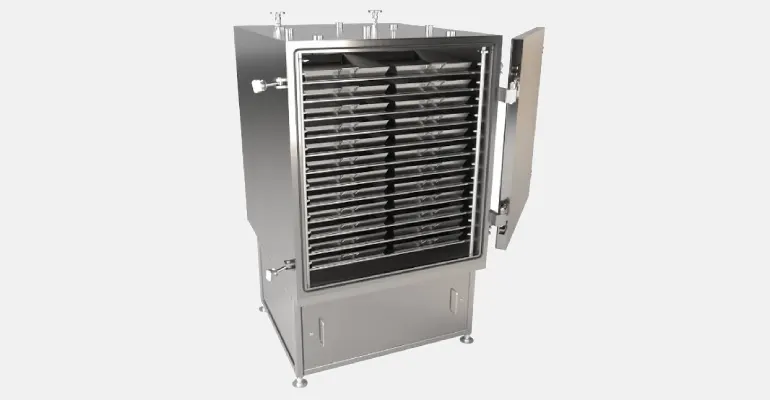
Tray Dryer
The operation of a tray dryer, a widely used piece of batch drying equipment, begins with the
careful preparation and loading of the material. Wet solids, granules, or pastes are uniformly spread
in a thin layer onto multiple trays, typically made of stainless steel. These loaded trays are then
systematically stacked within a moveable trolley, which is subsequently wheeled into the insulated,
double-walled drying chamber. The primary purpose of the chamber’s insulation is to minimize heat
loss and maintain a consistent, controlled environment for the material during the entire drying
cycle.
Once the chamber is sealed, the heart of the drying process—convection heat transfer—is initiated.
Fresh atmospheric air is drawn into the dryer through an inlet, filtered, and then passed over a bank
of heaters, which can be electric elements or steam-heated radiator coils. The air is heated to the
predetermined drying temperature, which is carefully controlled based on the thermal sensitivity of
the product. This hot air is then propelled by large blower fans, ensuring it is circulated and directed
across the surface of every tray in the chamber.
The continuous circulation of hot air over the material causes the moisture on the surface of the wet
solids to evaporate rapidly. This process, known as forced convection heating, removes the free
moisture by continually sweeping away the saturated air layer that forms above the product. As
surface moisture evaporates, a concentration gradient is created, causing bound moisture from the
interior of the solid to diffuse outward to the surface via capillary action. The high-speed, turbulent
airflow over the trays is crucial, as it lowers the partial vapor pressure and reduces the boundary
layer thickness, thus maximizing the rate of mass transfer (moisture removal).
FAQs
A Tray Dryer is used for batch drying of wet solids, powders, granules, and pastes using hot air circulation.
Drying takes place through forced convection, where heated air is circulated over trays to evaporate moisture.
Yes, temperature and airflow can be precisely controlled, making it suitable for moderately heat-sensitive products.
It is commonly used for pharmaceutical, chemical, food, and herbal products.
Yes, it has a simple design, is easy to load and unload, and requires minimal maintenance.