



Download Brochure
Request A Quote
Other Products
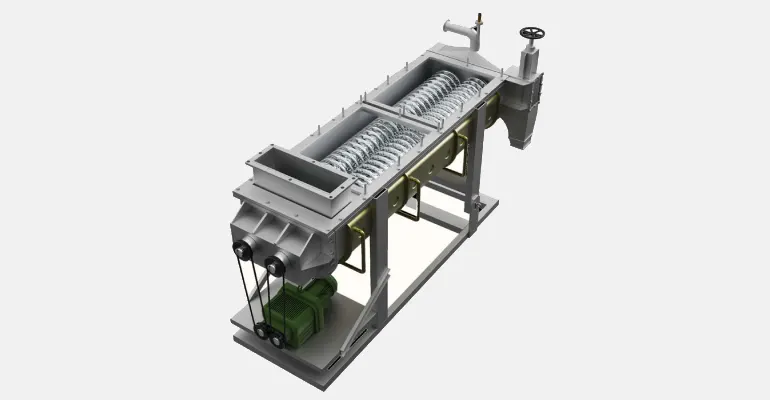
Paddle Dryer
The working principle of a paddle dryer is centered on a highly efficient indirect heat transfer
method coupled with powerful mechanical agitation. The drying vessel is typically a horizontal,
jacketed trough containing a central rotating shaft fitted with wedge-shaped, hollow paddles. A
heating medium, such as steam or thermal oil, is circulated through the dryer’s jacket and, crucially,
through the hollow shafts and paddles. This design ensures that the heat is conducted directly to the
drying surfaces, which are in constant contact with the material, while keeping the heating medium
completely separate from the product. This makes the process extremely energy-efficient and
suitable for materials sensitive to hot air or combustion gases.
The core of the operation lies in the agitation and transport provided by the rotating paddles. As the
shaft turns at a low speed (typically 3 to 20 RPM), the unique, self-cleaning paddle design creates
intense radial mixing and axial movement (plug flow) of the material. This continuous movement
ensures that all material particles are repeatedly brought into contact with the hot metal surfaces—
both the trough wall and the paddles themselves—allowing for uniform heat distribution and
preventing the formation of wet lumps or sticky buildup. The shearing action of the paddles is
particularly effective in breaking down moist agglomerates, which constantly renews the surface
area available for moisture evaporation
As the material is heated by conduction, the moisture within begins to vaporize. This evaporated
vapor must be efficiently removed to maintain the drying rate. In a continuous system, the material
gradually moves from the feed inlet to the discharge outlet. The vapor produced within the sealed,
or sometimes vacuum-assisted, chamber is collected and channeled out through a vapor exhaust
system, which may include a scavenging airflow, a cyclone separator, and a scrubber. Maintaining a
slightly negative or controlled pressure helps draw the vapor away and prevents unwanted air
leakage into the system, which is vital when drying materials that are solvent-laden or highly
reactive.
FAQs
A Paddle Dryer is used for efficient drying of powders, granules, sludges, and pastes using indirect heat transfer.
Heat is transferred indirectly through the jacketed trough and hollow paddles using steam or thermal oil.
It uses conduction-based heating with large heat transfer surfaces and minimal airflow, reducing energy loss.
Yes, since there is no direct contact with hot air or combustion gases, it is ideal for heat- and solvent-sensitive materials.
Moisture evaporates through heating and is continuously removed via a vapor exhaust system, often under controlled or vacuum conditions.